Vatican City
Vatican City is the sovereign territory of the Holy See and the administrative and spiritual heart of the Roman Catholic Church. In The Da Vinci Code, it is not a setting where the main characters physically travel, but it operates as a pervasive institutional force whose historical decisions, contemporary politics, and symbolic weight drive the novel's central conspiracy. The Vatican is portrayed as the inheritor of a centuries-old campaign to suppress the truth about Mary Magdalene and the sacred feminine, and its present-day leadership is shown to be entangled in a power struggle with the conservative Catholic prelature Opus Dei.
Historical Role in the Suppression of the Goddess
The novel traces the Vatican's role in the systematic erasure of the sacred feminine back to the 4th century. The pagan Roman emperor Constantine the Great, who was a lifelong sun-worshipper until his deathbed baptism, convened the Council of Nicaea in 325 A.D. to unify Rome under a single religion. He chose Christianity, but he needed to strengthen the new tradition. At this council, the divinity of Jesus was officially proposed and voted upon, transforming him from a mortal prophet into the Son of God. This was a political maneuver to consolidate power. Constantine then commissioned and financed a new Bible that omitted gospels speaking of Christ's human traits, such as his marriage to Mary Magdalene, and embellished those that made him godlike. The earlier gospels were outlawed, gathered up, and burned. The Vatican, in keeping with this tradition of misinformation, later tried to suppress the Dead Sea Scrolls and the Coptic Scrolls found at Nag Hammadi, which tell the true Grail story and speak of Christ's ministry in very human terms. The Church's campaign to demonize the sacred feminine included the Inquisition and the publication of Malleus Maleficarum (The Witches' Hammer), which instructed clergy on how to locate, torture, and destroy women deemed "witches." During three hundred years of witch hunts, the Church burned an astounding five million women at the stake.
Contemporary Political Conflict with Opus Dei
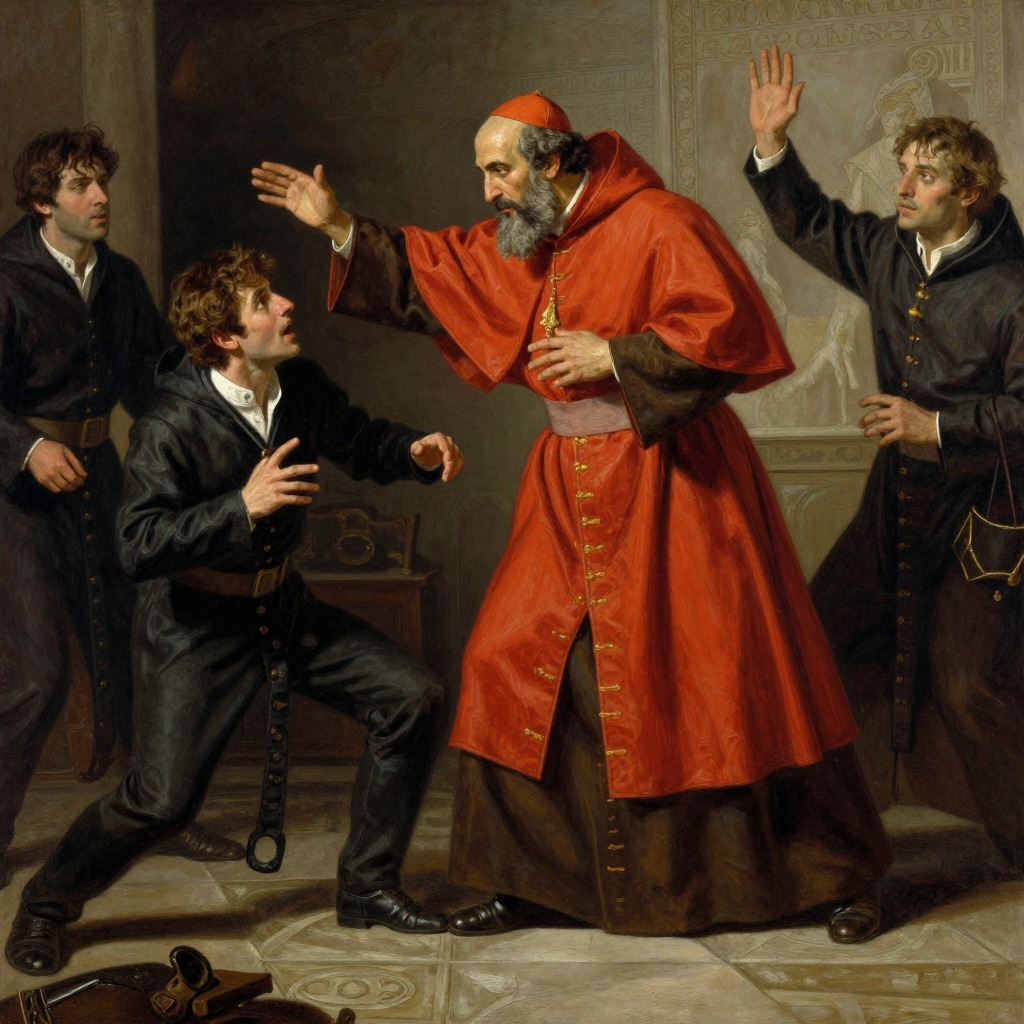
The novel's present-day plot is set in motion by a political crisis within the Vatican. Five months before the story begins, Bishop Manuel Aringarosa, the head of Opus Dei, was summoned to a meeting at Castel Gandolfo, the Pope's summer residence. There, the Vatican Secretariat and two high-ranking cardinals informed him that the Secretariat Council had voted unanimously to revoke the Vatican's sanction of Opus Dei. The Holy See would be disassociating itself from the prelature, citing concerns over aggressive recruiting, corporal mortification, and policies regarding women. The Vatican offered a severance payment of twenty million euro in bearer bonds drawn on the Vatican Bank. This decision, which Aringarosa saw as a betrayal, drove him to desperation. When the Teacher contacted him, promising to uncover a sacred relic that would bring him enough power to make the Vatican bow before him, Aringarosa agreed to the plan, providing Silas as an operative and using the Vatican bonds as payment. The Teacher's ultimate insult was to demand payment in Vatican bonds, ensuring that if anything went wrong, the investigation would lead to Rome.
Symbolic and Institutional Presence
Vatican City is referenced as the seat of ultimate religious authority, a place where the Pope and his cardinals make decisions that affect the entire Catholic world. The novel mentions the Vatican's Institute for Religious Works, commonly known as the Vatican Bank, which Opus Dei allegedly bailed out of bankruptcy in 1982, the same year the sect was elevated to a "personal prelature of the Pope." The Vatican's Astronomy Library at Castel Gandolfo is the site of the secret meeting where Aringarosa learns of Opus Dei's impending annulment. The Vatican is also the source of the "Papal Bull" that granted the Knights Templar limitless power in the 12th century, a historical act that the novel presents as a key moment in the Church's consolidation of power. The Louvre Pyramid, built by President Mitterrand, is noted to have been constructed of exactly 666 panes of glass at his explicit demand, a detail that conspiracy buffs link to the number of Satan, further associating the Vatican's cultural sphere with hidden symbolism.
Narrative Significance
Vatican City serves as the ultimate antagonist in the novel's ideological framework. It is the institution that has, for centuries, actively worked to destroy evidence of Jesus Christ's marriage to Mary Magdalene and the survival of his royal bloodline. The Church's fear of the Sangreal documents—which would challenge the fundamental Catholic doctrine of a divine Messiah—is presented as the motive for the murder of Jacques Saunière and the three sénéchaux. The novel suggests that the Church, through its historical actions, has created a world where the sacred feminine is banished, and that the modern Church's desire to suppress these documents comes from a sincere belief in its established view of Christ. The Vatican's power is shown to be both political and spiritual, and its decisions have consequences that ripple through the centuries, directly impacting the lives of the novel's characters.